AI models are now processing market data faster than any human trader ever could.
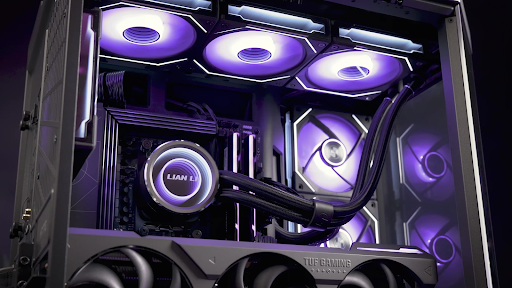
You spent months researching. You compared GPUs, debated RAM configurations, watched a dozen YouTube build guides. Finally, you assembled a $3,000 beast of a machine — dual monitors glowing, CPU humming, trading platform loaded. You were ready to beat the market.
But here's the uncomfortable truth: the moment you hit "buy," you were already behind.
The Speed Problem You Can't Solve with Hardware
The financial markets have always rewarded speed. In the floor-trading era, it was about who could shout the loudest. In the early internet age, it was about who had the faster connection. Today, it's about something no consumer-grade PC can compete with — artificial intelligence processing millions of data points per second, across every asset class, simultaneously.
Modern AI trading systems don't just react to price movements. They analyze earnings call transcripts for shifts in executive tone, parse central bank statements within milliseconds of release, monitor social sentiment across thousands of sources, and cross-reference satellite imagery of shipping ports with commodity futures — all before your trading platform has even refreshed its chart.
Your $3,000 rig runs at the speed of a human. These systems run at the speed of inference.
What AI Actually Does on the Market Floor
The largest hedge funds and proprietary trading firms no longer employ armies of analysts pouring over spreadsheets. Instead, they deploy machine learning models trained on decades of historical data, capable of identifying statistical patterns invisible to the human eye. These models operate in microseconds — executing, adjusting, and closing positions in timeframes that make "day trading" look like a geological process.
High-frequency trading firms co-locate their servers physically inside stock exchange data centers to shave nanoseconds off their execution times. The gap between their infrastructure and your home setup isn't a gap you can close by upgrading your processor.
And it's not just speed. AI models continuously learn. They adapt to new market regimes, shifting correlations, and changing volatility patterns. A human trader using technical analysis is essentially applying rules developed in the 1970s to markets that have been fundamentally restructured by algorithmic forces.
So What Are Retail Investors Actually Supposed to Do?
This isn't a eulogy for the individual investor — it's a reality check.
The edge that AI has over human traders is most pronounced in short-term, high-frequency strategies. Scalping, momentum trading, arbitrage — these are domains where machines have essentially won. Competing directly is not a strategy; it's an expensive hobby.
But the markets are not a single game. They are many games played simultaneously, and not all of them are dominated by algorithms.
Long-term, fundamentals-driven investing still rewards patience and judgment in ways that are genuinely difficult to systematize. The ability to understand a business, its culture, its competitive dynamics, and its long-term trajectory involves a kind of contextual human reasoning that AI models still struggle with. Warren Buffett's edge was never execution speed — it was the discipline to think in decades while the rest of the market thought in quarters.
There is also the emerging reality that AI tools are increasingly accessible to retail investors. Platforms now offer AI-powered portfolio analysis, sentiment screening, and risk modeling to individual users. The question is no longer whether you have access to AI — it's whether you're using it as a tool rather than trying to compete against it as an opponent.
The Real Cost of That $3,000 PC
Here's what nobody tells you in the trading forums: the psychological cost of active trading is often higher than the financial one. Constant monitoring, emotional decision-making, the illusion of control in a system that processes information orders of magnitude faster than you do — these are conditions designed to produce poor decisions.
Your $3,000 didn't buy you an edge. It bought you a very expensive front-row seat to watch algorithms work.
That money, invested in a diversified index fund from the day you started building that PC, would have begun compounding immediately. No setup required. No latency. No trading fees eroding your returns one transaction at a time.
The Smarter Question to Ask
The question isn't "how do I beat the algorithms?" The question is "what are the algorithms bad at, and how do I position myself there?"
They're bad at patience. They're bad at irreducible human judgment. They're bad at understanding things that have never happened before. And they're increasingly expensive to run at scale — which means the strategies they pursue most aggressively are the ones with the thinnest margins and the most participants.
The $3,000 PC is a symptom of a broader misconception: that trading success is a function of tools and setup rather than strategy and temperament. The most powerful upgrade you can make to your investing approach costs nothing. It's accepting that in a market increasingly shaped by AI, the human advantage lies not in speed, but in thinking differently about time.
Your money doesn't need to move fast. It just needs to move in the right direction, for long enough.